About the Founder — Mohammed Sufyan Binsadiq
Operational engineering discipline meeting advanced data analytics — built to serve the hospitality sector across Saudi Arabia and the GCC.

Founder & Lead Analyst of SIA Hub — Strategic Intelligence Axis, a specialized service that turns hotel guest reviews into decision-grade reports using an engineering-based strategic data-analytics methodology.
Based in Jeddah, Saudi Arabia.
Professional Background
Chemical engineer (King Abdulaziz University) with 8+ years of operational experience in high-stakes industrial environments — energy, manufacturing, and occupational safety. That discipline of reading operational data and converting it into executive decisions made hotel review analytics a natural extension of the same methodology.
Facts from the Earlier Industrial Career
The following are facts from the industrial work that preceded Strategic Intelligence Axis. They are stated because they are the origin of the methodology — not as an endorsement or accreditation of this service, and none of them implies a partnership with, or approval by, any government entity:
- 3 initiatives submitted to government entities in safety and strategic planning — submitted for consideration; no accreditation or contract followed from them.
- One million safe work hours across major industrial projects where he held safety-management responsibility — a figure from the former employer's record on those projects, not a performance metric of this service.
What is specific to hospitality is what you can read in the published case studies: real engagements with their numbers as they are, property identities withheld.
Qualifications & Credentials
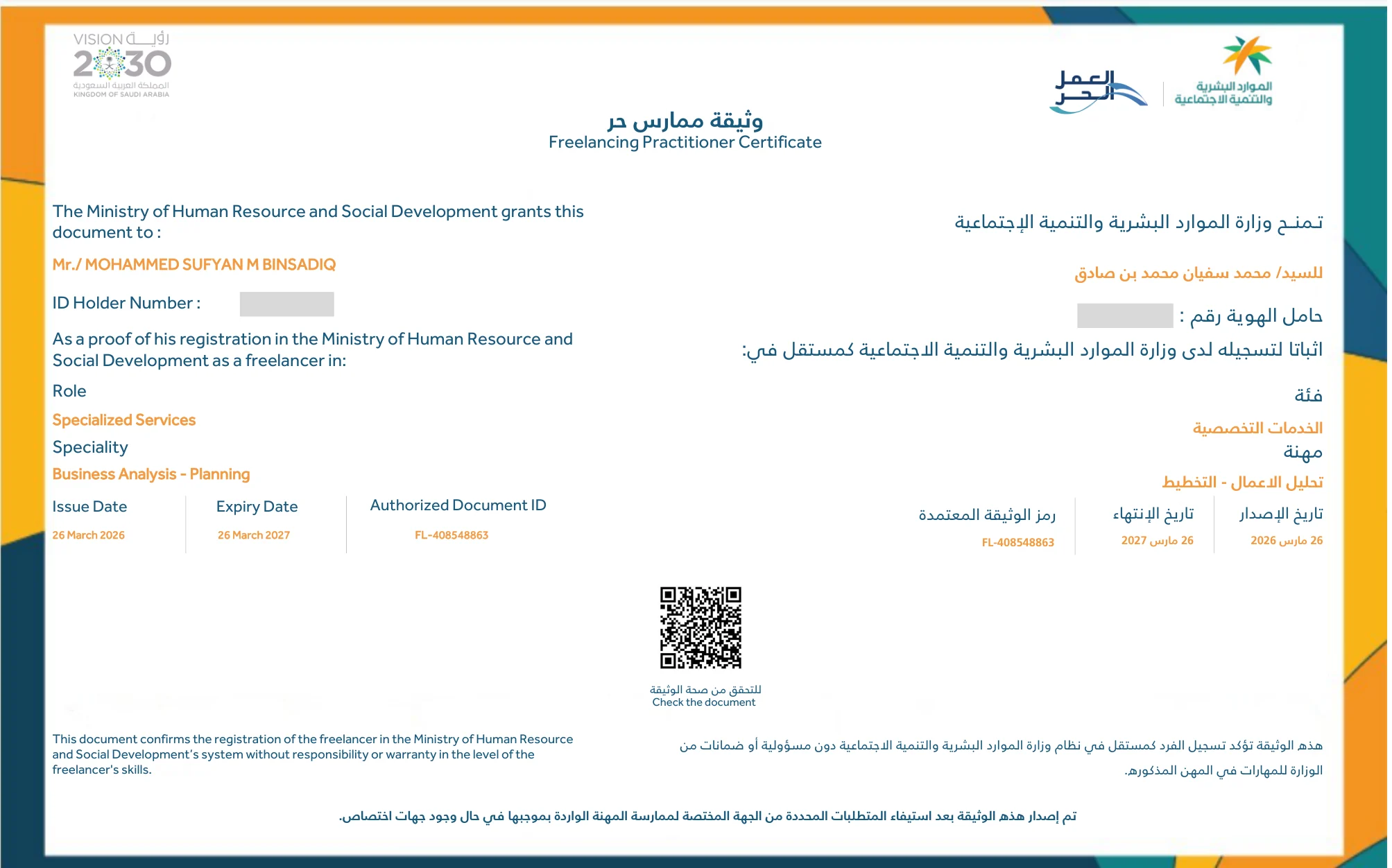 📜 Official MHRSD freelance work document — tap to enlarge (QR-verifiable)
Areas of Expertise
- Hotel review & guest-feedback analytics
- Hospitality operational data analysis
- Strategic planning & risk management
- Operational excellence and occupational safety
- Turning data into prioritized, measurable action plans
How the Work Is Done
Every engagement follows the same path: publicly published guest reviews are collected from the booking and review platforms in scope for the engagement — confirmed in writing before work starts — then each review is classified into 17 main categories and 130 sub-categories, and every issue is assigned to the operational department that owns it — one of 12 hotel departments — with a risk weight that sets its rank. Every negative entry is reviewed line by line before its classification is finalised; no classification is accepted without that review.
What comes out of it is a decision report (PDF) in every package, reaching 43 analytical sections in the full report (Enterprise). Added to it, from the Professional package upward, are a client Excel workbook holding the reviews classified entry by entry and an interactive dashboard (HTML) whose five tabs carry 21 KPIs and 25+ charts and run offline with no server. The report closes with executive recommendations, each with an owner and a timeline: six of them in each of the two published engagements.
Financial impact is presented as a conservative impact model with declared assumptions: each 0.1 point of rating gap below 4.5 is modelled at 1.0% of annual revenue (10% for a full point, against 11.2% in Anderson, Chris, Cornell Center for Hospitality Research, 2012), and the model stops at a one-point gap — an input for prioritisation, not an accounting figure and not a promised outcome.
What Is Asked of the Hotel
Three things only, none of which touches your systems: (1) the links to your property's pages on the platforms in scope — no passwords and no account permissions. (2) General operating indicators: room count, average nightly rate and occupancy — used solely for the financial modelling, approximate ranges are enough, and they are held under a confidentiality agreement. (3) One named contact to review the findings before they are finalised.
What remains after delivery belongs to the hotel: the report in every package, and the Excel workbook and the interactive dashboard from the Professional package upward — all of them standalone files that run on your side with no subscription and no permanent dependency on anyone. See package details.
Why an Engineer Analyses Hotel Reviews
Because a guest complaint is not an opinion to be measured by mood — it is a symptom of an operational failure that has an owner. An engineer who spent years on industrial incident analysis reads 700 reviews the way he reads a fault log: the question is never "what is the satisfaction score?" but "which item recurred, under what conditions, which department owns the fix, and what does leaving it cost?"
That difference is the whole distance between a report that says "cleanliness fell below expectations" and one that says "14 cleanliness complaints, 9 of them on the 4th floor between 2 and 4 pm, owner: Housekeeping, verification within 30 days". The first is read and forgotten; the second is signed and executed.
And because the method is human at its core, it is bounded by time: delivery takes 3 to 14 business days depending on the package (Basic 3–5, Professional 7–10, Enterprise 10–14).
Limits of the Service — What Is Not Offered
- This is not legal advice. Reports and guides are operational guidance; anything touching a legal obligation should be reviewed with a qualified professional.
- No rating increase is guaranteed. The report names the problem, its owner and its priority; the outcome depends on what the hotel executes.
- No passwords and no account access are requested. Only publicly published reviews are used, plus general operating indicators the management provides for the financial modelling, held under a confidentiality agreement.
- Replies are not managed on your behalf and your guests are never contacted; the diagnosis and the templates are delivered, the execution stays inside the hotel.
- No property identity is published. Case studies carry numbers and method only — no property name, district or tier.
Why SIA Hub?
Most global review-analytics services stop at aggregating numbers and measuring sentiment. This service focuses on the decision: root cause, measurable impact, prioritized action plan — bilingual (Arabic + English), tailored to the Saudi and GCC context.
To see it in practice: case studies · guides · the free review grader. For detailed questions on methodology, platform coverage, timelines and pricing, see the FAQ page.
Request your analysisLast updated: August 2026